
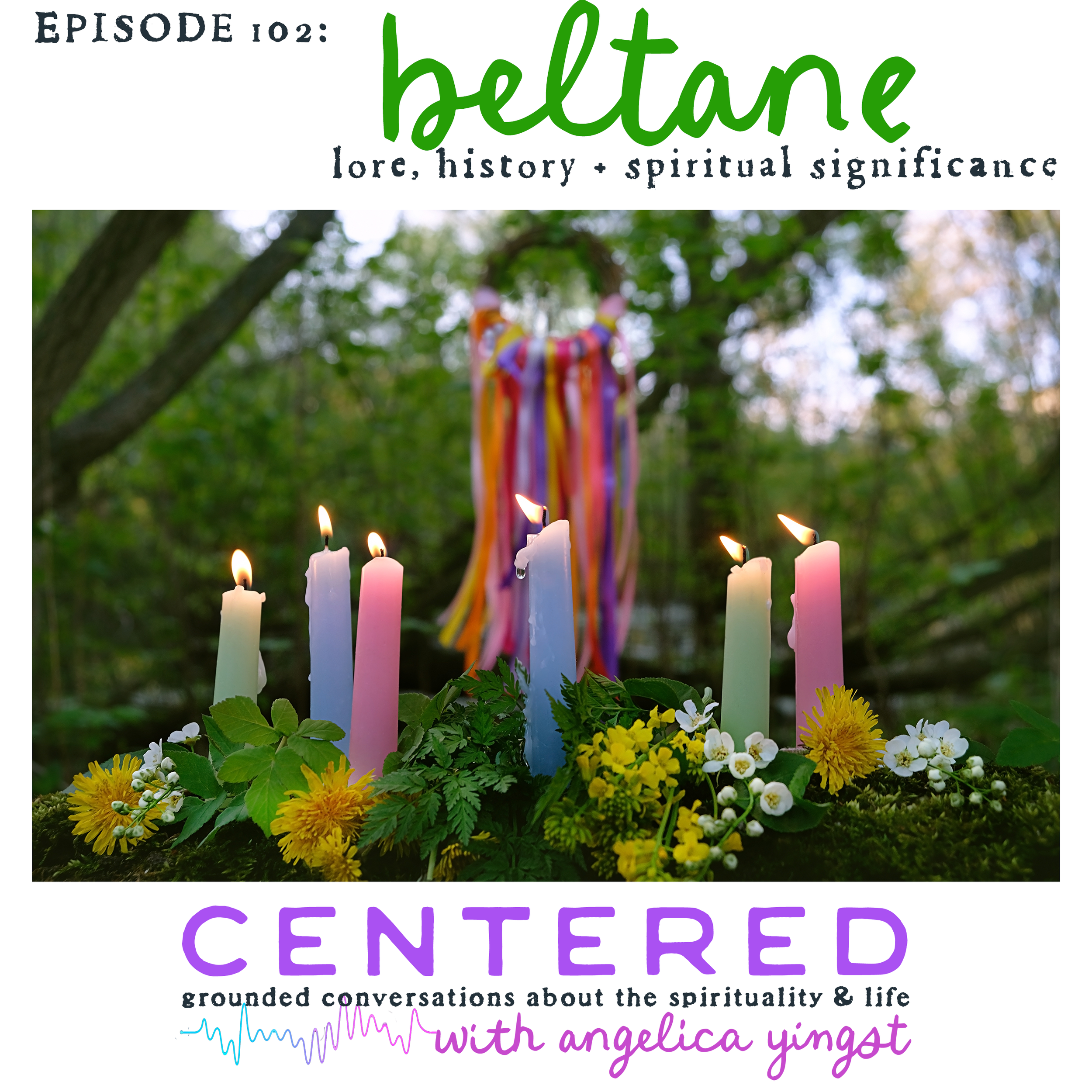
The Earth is not waking up anymore—she’s alive. Buzzing. Blooming. A little feral, honestly.
This is the season of fire, fertility, creativity, and connection. The moment where what’s been quietly growing says, “Okay… now we live.”
In this episode, we talk Beltane as a threshold—where desire meets action,
where creation asks for courage,
and where life gets a little louder in the body.
We work with Rabbit medicine (soft, alert, wildly fertile) and explore what it means to step out of hiding
and into the open meadow of your own life.
No perfect ritual required. No pressure to get it “right.”
Just this question:
What in you is ready to live?
New episode of Centered is live. Find it on Spotify or wherever you listen to podcasts. Or, listen right here on the blog:
Episode 97: The history and lore of Imbolc: a stirring of the seeds
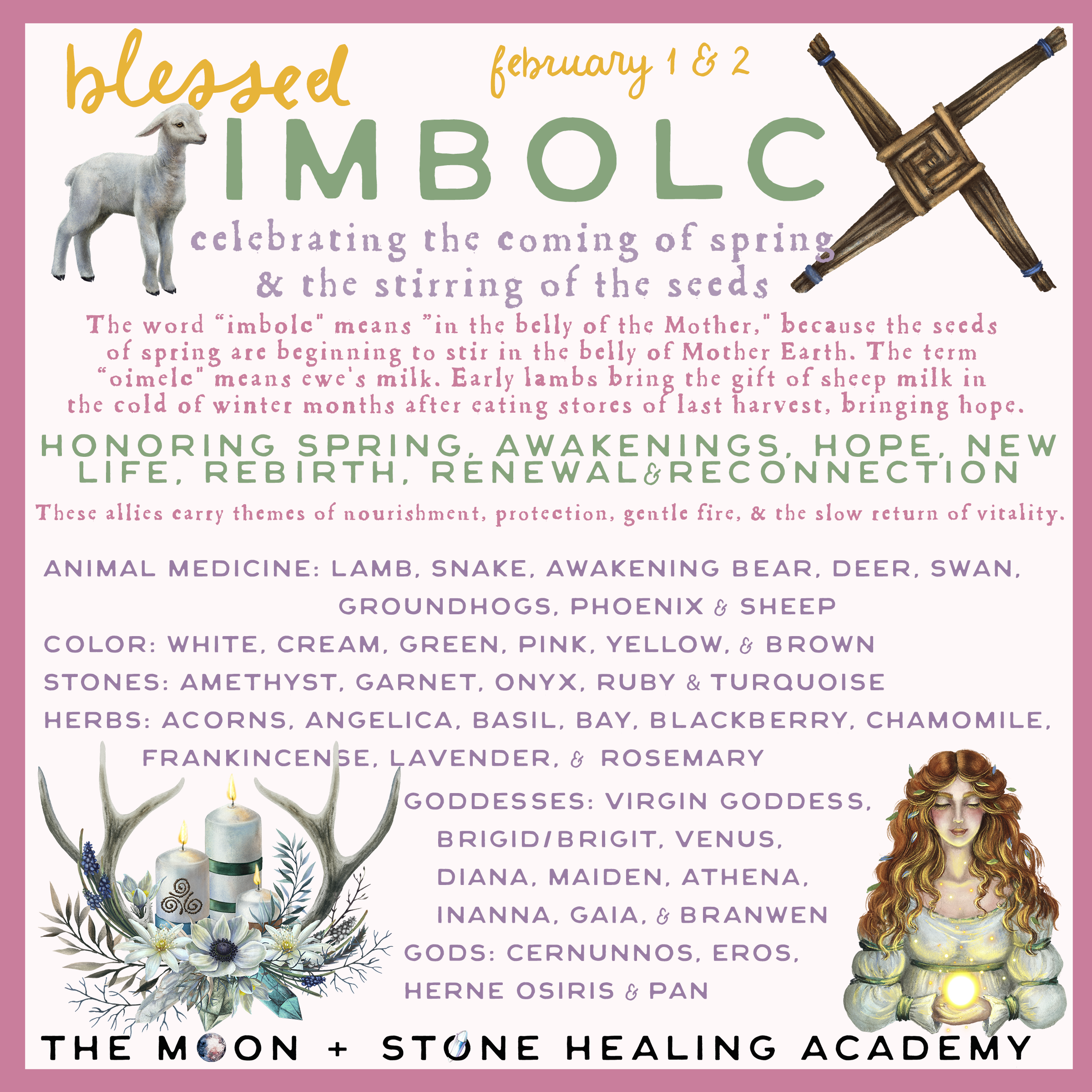
Imbolc arrives as a whisper between worlds — a quiet hinge between the deepest dark of winter and the first subtle return of light. Though the land may still be covered in snow, life is stirring beneath the surface. In this episode of the podcast, we explore the ancient roots of Imbolc, the layered meanings of ewe’s milk and “in the belly of the Mother,” the mythology of Brigid, and how this season invites us into gentle preparation, purification, and tending the seeds we’ve planted. If you’ve been feeling something quietly shifting inside you, this episode is for you.
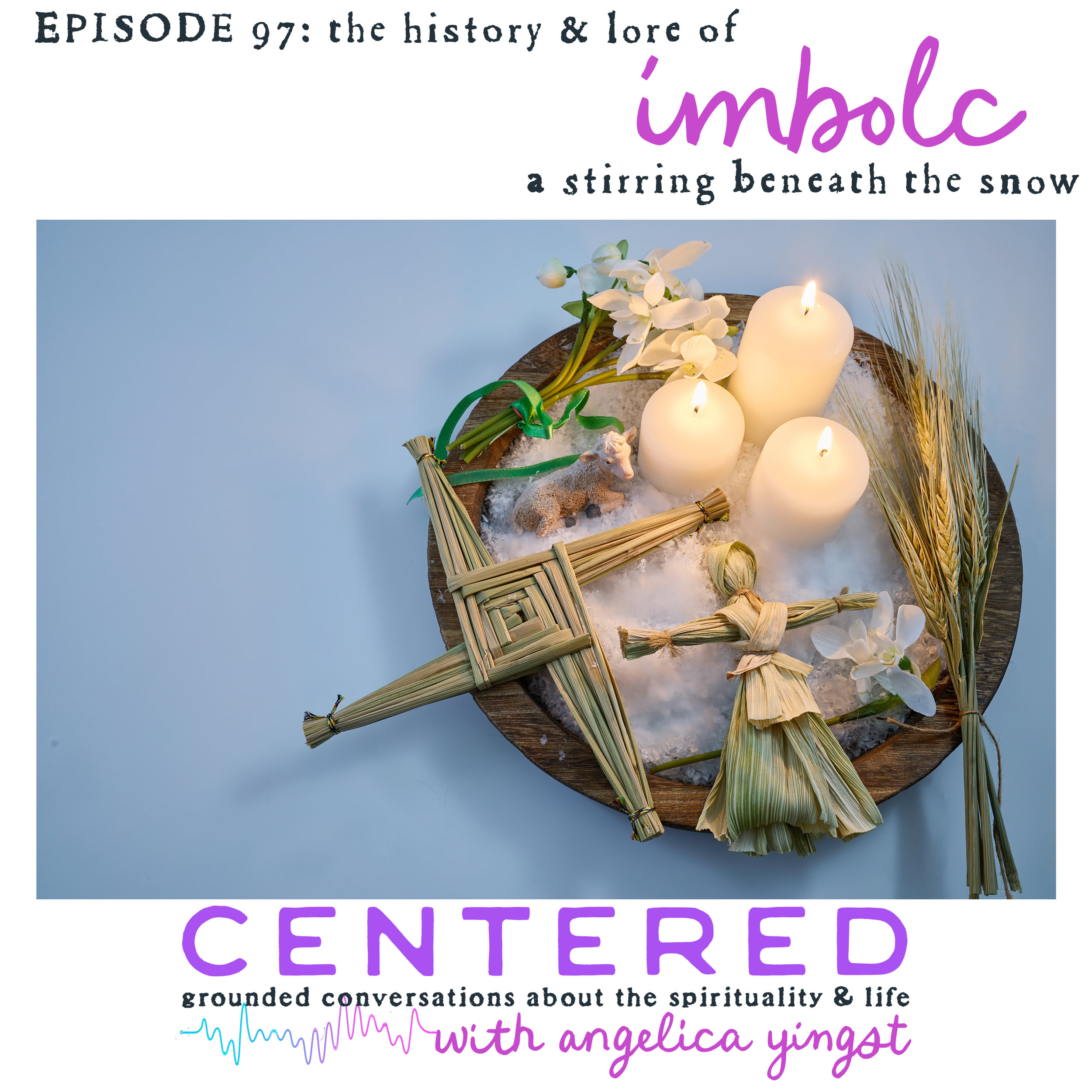
Click the graphic above to listen on Spotify or listen on the blog below.
Episode 89: Re-post The History of Samhain, Halloween & the Days of the Dead
We’re going back to the roots of spooky season, my pretties. This re-post dives into the ancient fire festival of Samhain and how it shapeshifted into our modern celebration of Halloween. From Celtic bonfires to trick-or-treating, saints to spirits, and mummers to masks, we’ll explore how humans across the world honor their dead when the veil grows thin.
This one’s a listener favorite, so light a candle, pour a little cider for your ancestors, and let’s walk together between worlds.
#Samhain #HalloweenHistory #WheeloftheYear #PaganTraditions #HonoringtheDead #SpookySeason
Some sources:
How the Early Catholic Church Christianized Halloween by Patrick Kiger
The Pagan Mysteries of Halloween. JeanMarkale.Trick or Treat: A History of Halloween. LisaMorton.The History of HalloweenWhat's the Deal with Halloween? Everything Everywhere.
The Origins of Trick or Treating History Channel.The History of Mummers.
Interested in being in circle with me, honoring the dead on Samhain?
I am hosting a distance ancestors cacao ceremony and guided shamanic journey. Connect with the ancestors and find healing in your ancestral line. It is a wonderful way to start doing the work of healing and honoring the agrarian calendar.

talking to the ancestors
Future Ancestors,
As I look out on my land, I hear my ancestors whispering in my ear.
We are always here.

I know this, and yes, I need their strength all the time.
I did this incredibly rich ancestors' journey with Vanessa Codorniu. at Alta View Wellness Center a few years ago. I talk about this every year, so forgive me if you have heard it before. During that experience, I was just open. I love Vanessa and trust her, so maybe that is why.
I had no agenda. I had no idea who would come forward, but I journeyed to Central America, where my family is from, and saw them all there. My mother’s Abuelita Isabel with the curly hair. My grandfather’s mother Maria, who was fully Native, with her hat and pipe. Then out of the jungle, my ancestors with Mayan noses and headdresses and painted skin. Sitting in front of all of them, Vanessa asked us to talk to them. And so I did.
I had so many questions, particularly about offering of cacao to my people, and how to carry the medicine of my ancestors to my clients now. But when I went to ask them that, what came out was, “Why am I so fat? Why can’t I lose weight? Why do I have autoimmune issues that limit me?”
I had a student once tell me she was annoyed in our circle because people’s intention setting was around losing weight, and “THAT IS NOT SPIRITUAL!” She was so indignant. In my head I said, “The fuck it isn’t.” As a woman, when you are raised to see your weight and beauty as your main worth and commodity, being thin is valuable; it was much more valuable than your mental or physical health—gaining weight becomes a catalyst for old wounds opening, the spiritual illnesses of self-loathing and non-existent self-worth. How do you grow spiritually when you hate yourself?
There were times in my life when I was too poor to afford to eat regularly. I often worked in restaurants, so I would be guaranteed one meal. Other times, I just starved myself because I thought I was too big, too loud, taking up too much space. My neurodivergent hyperactive self would just break into conversation without waiting for a pause (Interrupting is STILL something I’m working on!). I wanted to shrink myself and learn how to be quiet and small for real for real. I didn’t always want to say the thing, and then, like Cliff Clavin from Cheers, word diarrhea—"well, did you know that a vultures’ stomach acid is so strong with a pH of 1—that it can dissolve anthrax, botulism, and rabies bacteria, so they can safely eat rotting carcasses that would kill almost any other animal, essentially sanitizing the environment as they go…” Cue 15 minutes of watching someone zone out. Then at night, lying in bed, replaying the conversation where I was normal. Shrinking seemed right, so I would just try not to eat, and stay small.
Self-loathing is decidedly not spiritual. It is the antithesis of spiritual, especially when your entire job revolves around empowering people to their highest expression, to coaching them on how to do the work of radically and unconditionally accepting themselves, walking hand-in-hand with them on their spiritual journey. I have taken months and year-long breaks because the self-loathing is too rough, and it feels unethical to hold space for others when I am in such a deep state of depression and engaged in this personal work of self-acceptance and self-love. So, yeah, it’s spiritual work, people.
Dare I say it:
EVERYTHING IS SPIRITUAL WORK!!
(I apologize for screaming at you.)
Back to the journey, my ancestor stepped forward and said:
You are the answer to all the prayers and wishes of all your ancestors: May our children not be hungry. May they be fat and happy. You are the child who is no longer hungry. You have learned to eat and be nourished.
When we do ancestral healing, this is what we do. We dialogue with our ancestors. We reframe. We understand. We humanize. We integrate. We break patterns. We forgive. We allow their wounds to be our wisdom.
What prayer did you answer for your ancestors?
+ + + + +
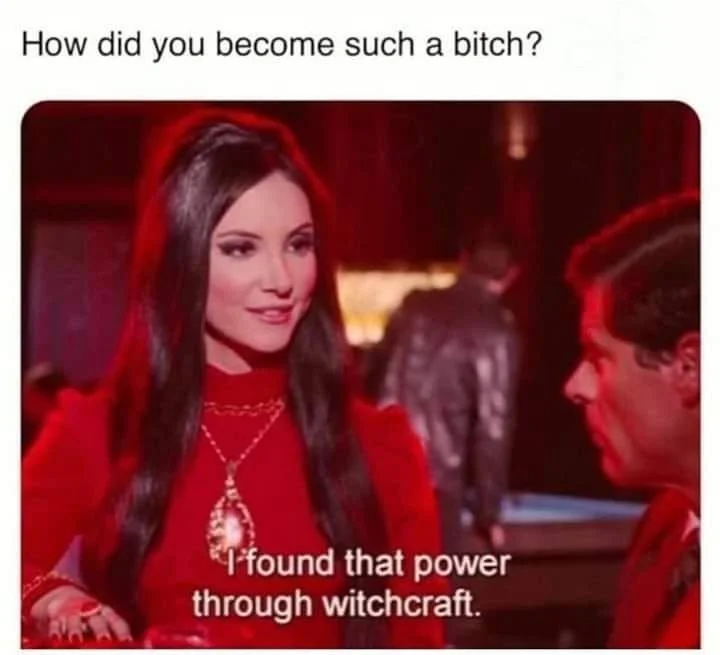
A few years ago, my niece said to me, "We come from a long line of witches, right?" And I laughed. It depends on how you define witch. But yeah, we come from a long line of Bitches.
When I call in the ancestors before circle, I call in all the healers and mystics in my lineage. But I also come from a long line of storytelling artists and mystics, bawdy women with good heads on their shoulders, from cooks and musicians, teachers and writers. But the drunks are there too, the ones who acted badly. I have a great-grandmother who denied her own daughter because she cheated on her husband, and gave her daughter away, only to have her son bring the girl to the house as a date to a school dance. Fula, as they called her, looked exactly like her mother, a mirror for her sins. (You cannot make this shit up.) She still denied her and forbade her son from speaking to her. Later, all the children of my great-grandmother welcomed her into the family. Fula laughed a lot and came to every family function, but my great-grandmother never talked to her or acknowledged her existence. God, that is some awful behavior. But my great-grandmother played 9 instruments, and spoke five languages, and made people laugh all the time.

I have clients and students who say, “My ancestors were awful people. What do I do?” First of all, it isn’t just you. We all have ancestors who were awful people. Some in different ways, but that is when we do the work of looking at the legacy of awfulness in your family line. If you don’t know your family line or family stories, that is something else to look at. WHY? The legacy in your family is that they do not speak the stories. Maybe they even repeat patterns over and over because nothing is ever learned or grown from. How I work with my great-grandmother, who was lovely to some of her children, and awful to one, I say, “Thank you for letting me be able to see this and break the pattern of the bad mother. Thank you for allowing me to break the awfulness.” (Instead of awfulness, you can replace that with breaker of our family trauma, pain, abuse, addiction, victimhood, etc.) When we reframe our ancestors —putting them in their historical, trauma, and family context —we can find wisdom, even if it is learning from their sins. Sometimes the deep grief of lives not lived, or their actions, can move through us. We can cry for our family lineage. We can cry for their victims, for ourselves, if we were the victim or them as a victim and victimizer.** This ancestral work is about healing and releasing. We get to be the conduit for compassion, love, and grief if we feel the ancestral lineage hasn’t been compassionate or grieved enough. We get to acknowledge the awfulness of our ancestors, too.
But we transform grief into gratitude through this process. Not for having lost, but for them having lived at all. They brought you here, after all, they created people who created people who created you.
Our Ancestors —the good, the bad, and the ugly —have lessons for us because they were human. This is the medicina they bring forth—their humanness. And not that anyone wants my opinion on this, but this is the beauty and awe of the stories of Buddha and Jesus—their humanness existed, their flaws, their character defects and defaults, but still they sought to heal themselves, then others. They found a path of spirituality that helped them and passed it on. This is also the lessons of our ancestors—that they were human and had a story, which is now part of your DNA. (Epigenetics is a cool rabbit hole to go down)
+ + + + +
Beyond just dialogue with my ancestors, I also think about what it means to be a good ancestor.
How do we become an ancestor vs. just another people on the family tree who died?
Writer Layla Saad, whose podcast How to Become a Good Ancestor, prioritizes this concept, as is evidenced by her podcast title. Basically, she says we need to live and work in a way that intentionally creates a more just and liberated world for future generations. That’s the idea. We live in a way that thinks about the next generations, the earth, the future. We each have a role in the ongoing story of humanity. We focus more on making a positive impact, rather than on our personal achievement. And that doesn’t happen magically, it happens by us engaging in our own spiritual, mental, emotional and physical work, such as self-reflection and understanding one's own role in family systems. Being a good ancestor requires us to break patterns of suffering, not just in our personal lives, but the karmic and ancestral patterns we all fall into that keep our children in suffering and then suffering of our community, which means dismantling things like racism, sexism, ableism…other isms (In recovery, we say -ISM stand for I-Self-Me.) We take intentional action and live from a place of hope, rather than just hoping for the best.
+ + + + +
I create an altar for Día de los Muertos* in mid-October, when I begin to feel the ancestors pushing against me. I call them in. Ask for their help. It is not simply because I come from a culture that celebrates this holiday (though I do), but because I am a bereaved mother. And this American happy-happy culture does a lousy job of honoring the dead and grief.
Day of the Dead is one of those holidays that has grown more and more mainstream with non-Catholic, non-Latino people creating altars, painting their faces, hanging up decorated sugar skulls, and dancing into the night. That isn't happening because others want to become or appropriate another culture, but because we are all hungry to honor our dead. We want to celebrate our ancestors. We want to walk with death, rather than hide our grief and whisper to our dead in the still of the night. It is only in recent history that the dead were hidden away from us, or that we were protected from the dying, the dead, and grief. All cultures from Europe to Asia to Africa to the Americas honored the dead.
So Day of the Dead, I create a space for my ancestors and my predeceased ancestral daughter, hang a painting of her and me that I painted in the early days after her death, and another of my ancestors, the ones that whisper to me in my sessions. I put calaveras and bright colors all around the altar as well as food, water, flowers and candles. In my mother's native Panama, my family walks to the cemetery to have a meal with the dead. They decorate the graves and commune as a family.
Those weeks with my Día de los Muertos altar are not simply a time to grieve, but a time to celebrate life. When we honor our ancestors, we acknowledge the wisdom they have given to us in life and now in death.
It is easy to create an ofrenda, or altar. Place photos of your relatives and ancestors in the space that feels sacred. I often use the top of my bookshelf or an undisturbed space. My mother uses her kitchen windowsill, which I always love too. You can put a candle, offerings of food, or herbs. Place a skull or skeleton (if you love the morbidity of representing the dead) and flowers. It can be as simple or as elaborate as you want. And you don't have to do this only for the ancestors you feel closest to, but also for those whose lessons were deep and difficult. Do it for your peace. If you have no ancestors you want to honor, do it for an artist you admire (Frida, anyone?), or a musician who has passed over. The days of the dead are considered October 31, November 1, and November 2nd. On October 31, All Hallows Eve, it is said the souls of the children who have died come back through the altars to the angelitos. According to tradition, the gates of heaven are opened at midnight on October 31, and the spirits of children can rejoin their families for 24 hours. The spirits of adults can do the same on November 2. November 1 is All Saints Day, when the ascended ones, saints, martyrs, and the angels are honored.
+ + + + +
If you are looking for a guided way to honor the dead, join me on October 31st for Cacao Ceremony & Muertos journey. We will first partake in the sacred cacao, then move into a shamanic journey to connect with the dead—whether it is your passed-over parent or loved one, your grandparents, ancestors you never met, but want to connect with, or a famous artist, sacred figure, philosopher, thinker, or religious figure. Join me on Friday, October 31st for our circle.
Lots of bonuses with this one, including a how-to guide for your ofrenda, how to make a cup of cacao, how to bake pan muerto or sugar skulls, and of course, the healing work we do together in circle. Everything is recorded if you cannot attend live.
*You can read more about El Día de los Muertos at this History Channel link. Just a quick correction, though, we celebrate it in Panama and throughout Central America, so it is not only a Mexican holiday.
**In the Body Keeps Score by Bessel Van Der Kolk , he talks about how PTSD sufferers from the Vietnam War often recounted the trauma they inflicted on others as the trauma they could not heal, because there is no outlet for talking about the awful things they did that they were ashamed of. Just to get nerdy for a minute, the unique part of training for troops going to Vietnam was the way they trained soldiers to fire at object popping up. In previous wars, they trained more as target practice, but since researched showed that a majority of soldiers in WW2 and Korea just froze when confronted with an enemy, the military decided to train them to shoot at moving objects with no faces or human characteristics, so they would freeze less. In the end, there are men responding to movement with gunfire and casualties of civilians and children were so high.
I hope to see you at the circle. Until then, enjoy this playlist I pulled together for Día de los Muertos.
+ + + + +
Have you worked with me?
I just want to humbly thank you for being part of my small business. Healing work, spiritual circles, coaching services, retreats, online classes and in-person classes, healing circles, and tarot readings are very personal experiences. Most of my clients, students, and workshop participants come from word of mouth. People love to hear about an actual experience with a healer or tarot reader.
I am looking for testimonials around my work as a shamanic earth medicine practitioner, retreat leader, tarot reader, teacher, healer, and circle keeper. Just share about what you have gotten out of an in-person or online class with me, a private one-on-one session or a group healing event you attended. If you belong to my membership group, I’d also love to hear and share your feedback about my monthly readings, shamanic journeys and FB group.
Fill the form below and share your feedback with me. If you don’t mind sharing your photo to showcase with your testimonial, awesome! (send via email at angie@themoonandstone.com) Otherwise, I will just share your words. If you had a less-than-ideal experience, I’d love to hear that too. All feedback informs how I adjust and change classes and offerings in the future. Here is the information I would love to have:
Name: First Name and Last Name (But what you want to be referred to publicly)
Email
How have you worked with Angie?
What was your experience like?
Please share anything else you would like.
blessed samhain!
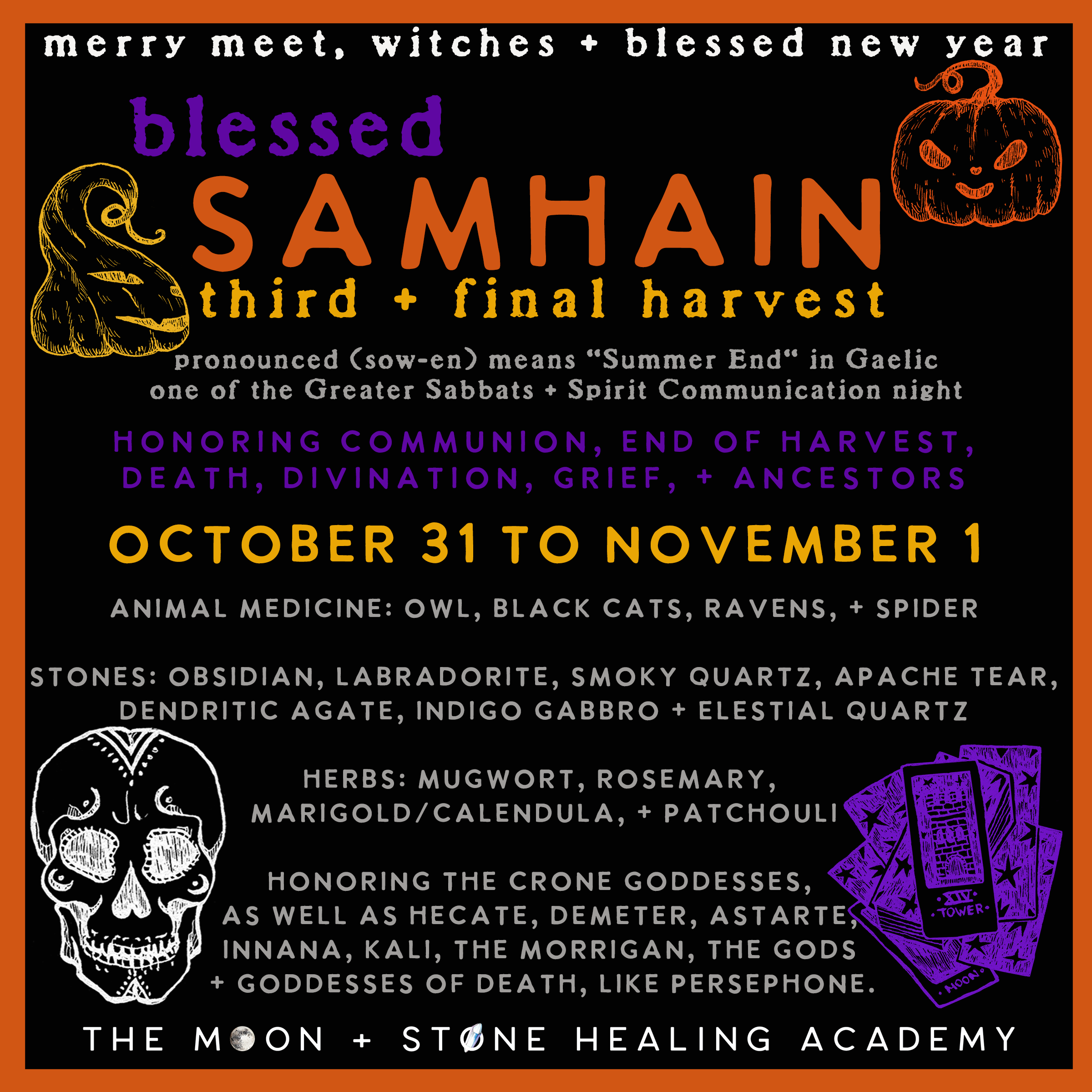
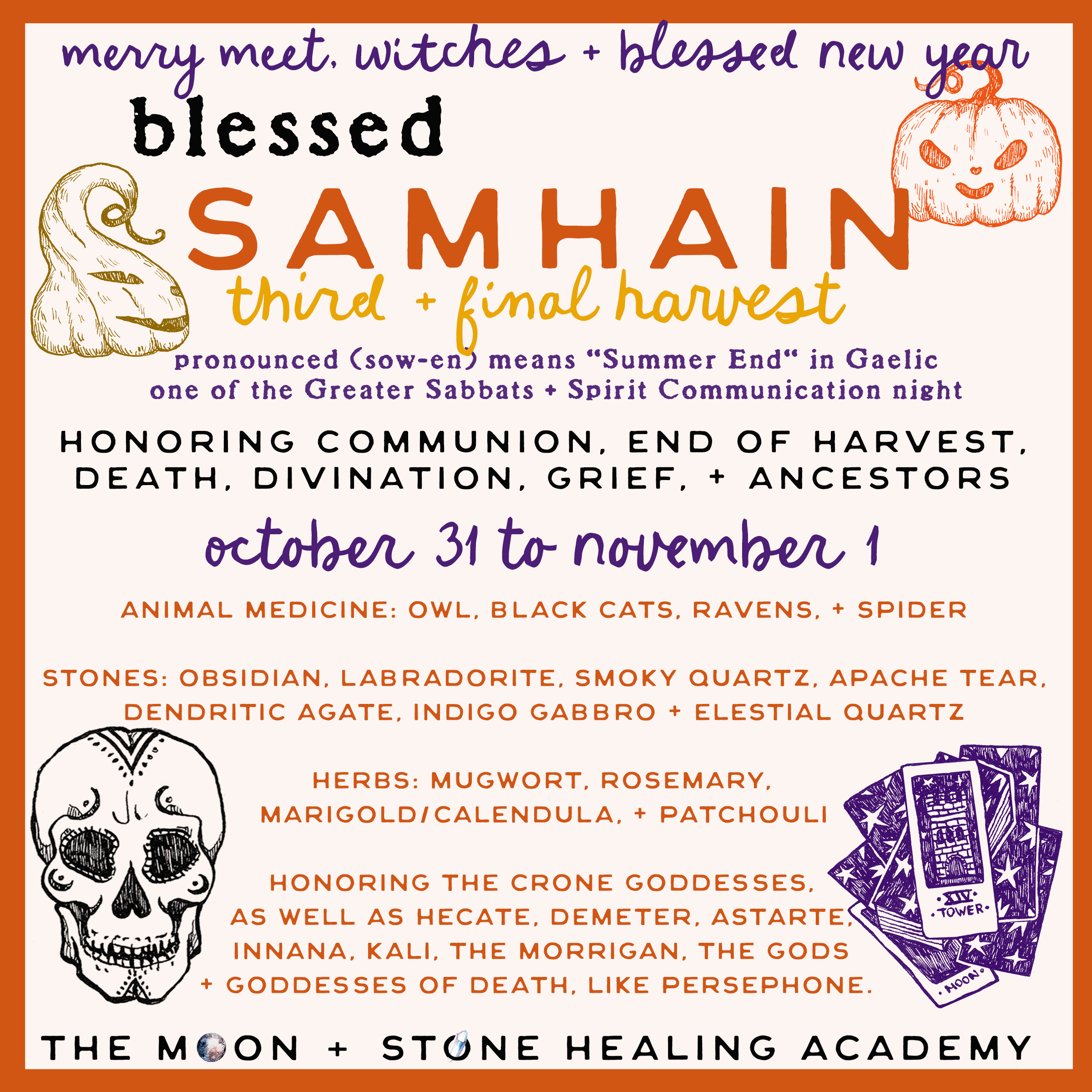
Samhain (pronounced SOW-en, meaning Summer’s End in Gaelic), the third and final harvest festival, marks the beginning of the dark season for Wiccans and Pagans. Considered the most important day on the Wheel of the Year’s calendar, Samhain falls on October 31st to November 1st. It is the start of Winter in the Witches year. Many consider this New Year.
Agrarian communities clear their fields before Samhain, as lore warns that food harvested after Samhain somehow spoils and can only be left for night spirits, faeries, and the wandering dead. The community prepares for the long winter by drying the medicinal and magical herbs, canning, and preserving fruits and vegetables. Root vegetables are harvested and stored in the cellars for the long winter ahead. This is also traditionally the time when farmers butcher the animals for winter, drying and storing the meat to survive through the long winter. The meat salted and kept, and the bones thrown to the fire as an offering to the Gods and as a security for good fortune. (Bonfire= bone + fire)
In this way, the Horned God, an aged and matured stag, gives his life again so the people can survive the winter. The God is mourned over the three harvests—first as the Grain God, then as God of Harvest, then the Horned God. The Goddess grieves and as she does, she transforms into the old, wise, and wizen crone. The Goddess, worshipped through the year in her three aspects, never dies, just as the Earth never dies. Travels to the underworld, as in the stories of the Sumerian goddess Inanna, Demeter/Persephone, Mabon and more tell us about the way we conquer death and the proximity of our loved ones.
So many cultures celebrate the dead at this time with Halloween (a secular holiday that has borrowed Samhain’s revelry), Día de los Muertos, All Soul’s Day, Feast of the Dead…this is the most holy of days. Though each sabbat honors the cycles of life and death, Samhain formally honors the Dead. The veil between the living and the dead thins during this time—almost all can sense the connection to the ancestors, spirits, and faeries. When the animals are slaughtered at Samhain, farmers also decide which animals live—fed and housed during the long winter months. This is a big decision and commitment for farmers which often sacrifice food from their family for the keeping of their animals.
There is revelry and celebration at Samhain--magick, divination and spirit work performed at this time. But the Spirits and Fae are not always seen as allies, they are trickster, mischievous creatures right now. Unlike Beltane, people are not looking to spend all night outside. The night holds mystery and fear. So, offerings—food and drink—are left outside the doors for the Spirits and Fae. Feeding the dead remains an important part of the rituals around the world honoring the ancestors. These offerings ensured good fortune on the animals in the barn and the crops for the next year.


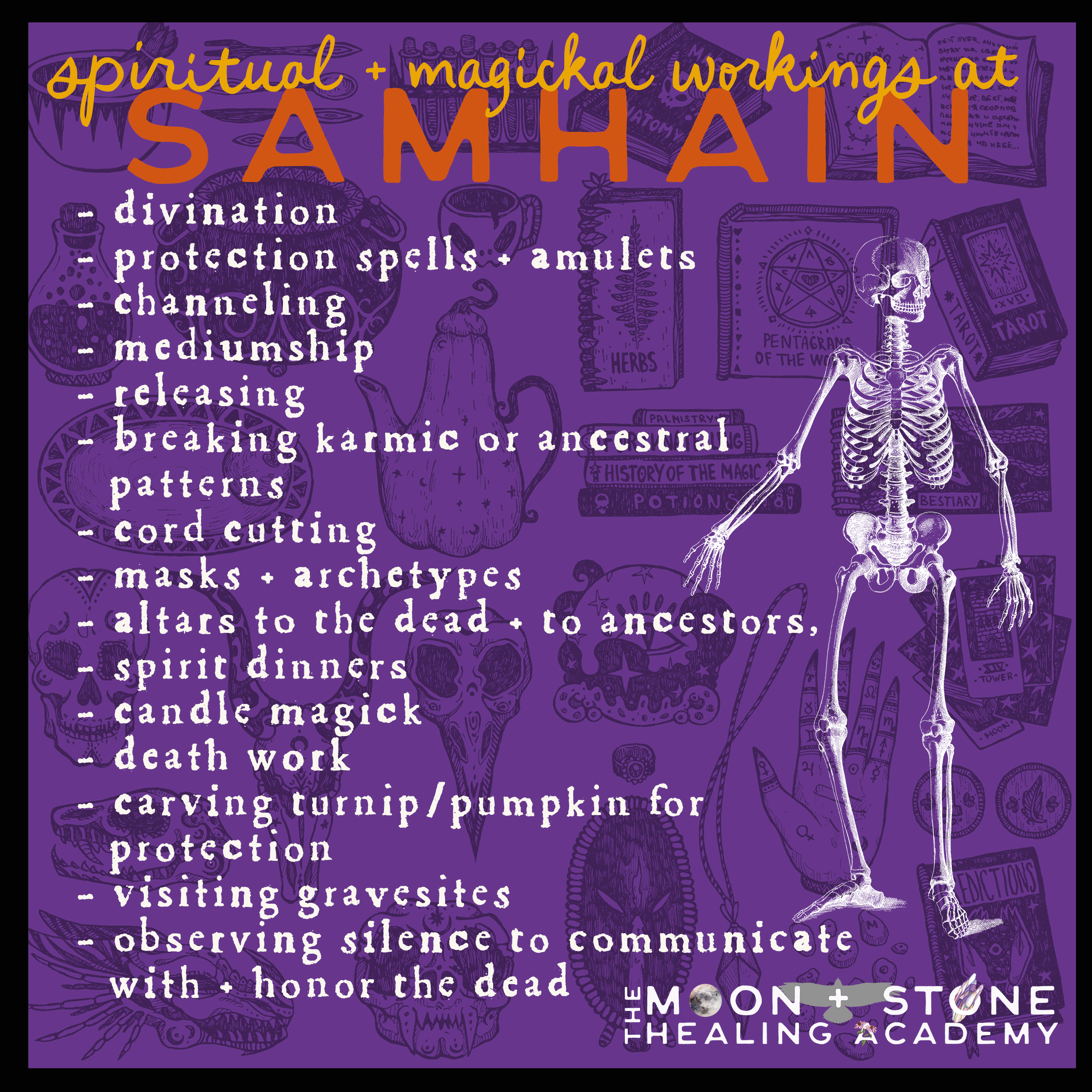
Because of the magical connection of this time, divination is extremely important part of this time—tarot, scrying, astrological year readings, runes, tea leaf readings, mediumship, and bone readings, where people’s names were written on bones or rocks and thrown into the fire. The next day, the bone or rock was “read” to tell the fortune of the person. Covens and families hold silent dinners where the dead are invited to share a meal. A place setting and plate of food is set in honor of the dead, and all stay silent, waiting for messages from the dead.
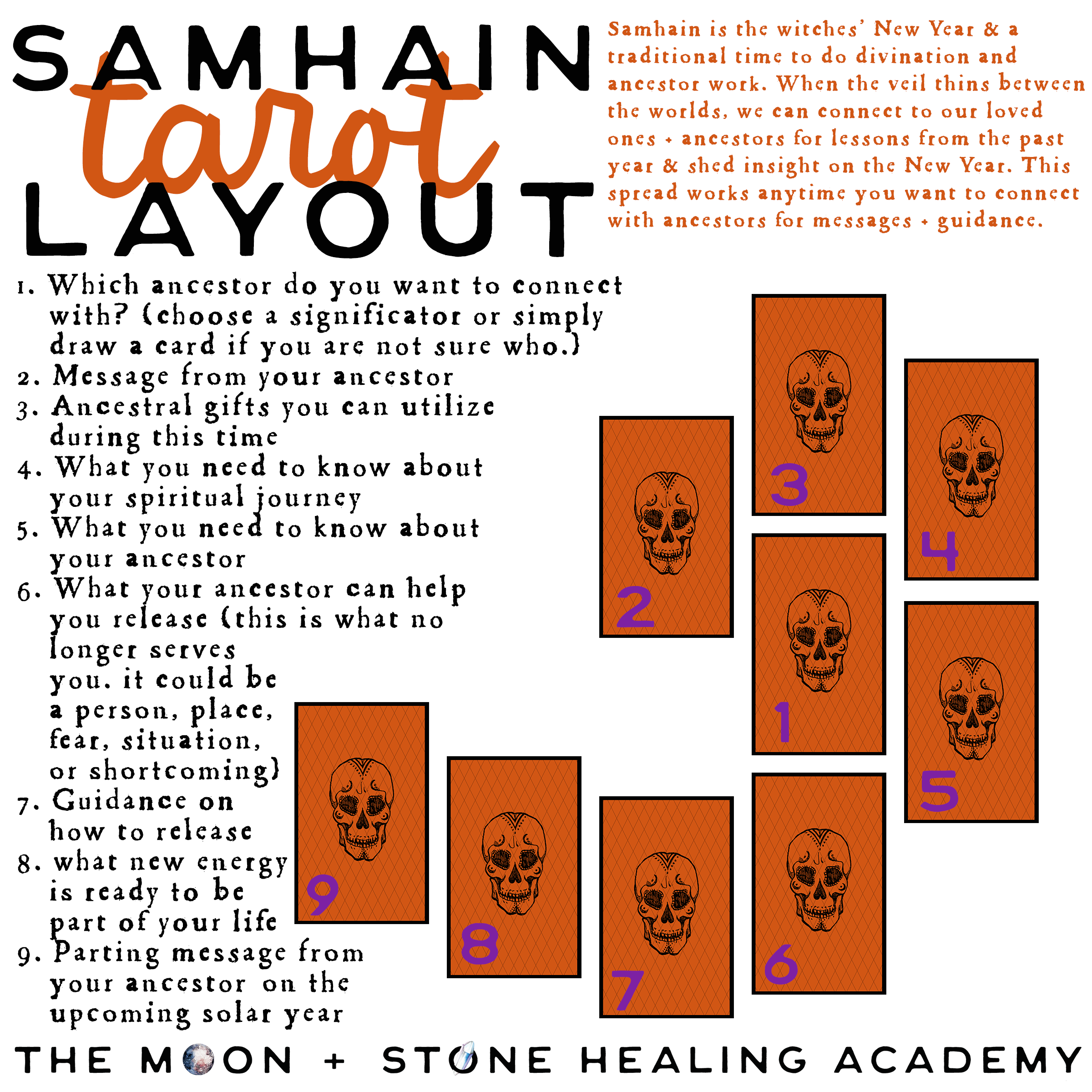
At Samhain, you are asked to connect with the Ancestors and your relationship with grief and death. Honor the ancestors and they can assist you on your path. Samhain is a magical time, so you are asked to take a divination method to connect to those who have passed over and the ancestors. Use whichever is your preferred way to connect to Spirit, and ask questions about the new year, about your spiritual journey and what is next for you.
I have created a Tarot Layout to connect with your ancestors and find out more about your new year.

This Samhain, I recorded a different kind of podcast, which is a history of Samhain and mostly, the modern Halloween…where does it come from and where are its roots in the old ways. You can listen on Spotify, Apple Podcasts, Google Podcasts, Pocket Casts, Overcast, Radio Public, or wherever you listen to podcasts.
Blessed Autumn Equinox!
Blessed Autumn Equinox!
Autumn Equinox or Mabon comes any time between September 21-23. As one of the lesser Sabbats on the Wheel of the year, it has a more modern approach from witches and pagans, but do not be mistaken--this time of the year has always been celebrated as the Second Harvest on the Wheel of the Year. First Harvest is August 1 when we celebrate Lammas or Lughnasadh honoring the harvest of the delicate grains, including wheat, corn, and others. Second Harvest celebrates the more abundance harvest of again corn, root vegetables, squashes, gourds and pumpkins, fall fruit including apples, pears, grapes, plums and others, and other abundant crops that last in root cellars through the winter. Third Harvest festival is Samhain, celebrated Oct. 31st, when the fields are basically done, and animals are harvested for winter.
Just for reference, the Wheel of the Year is a way on understanding what are called the Solar Festivals, or the eight points on the year that are celebrated in connection to agrarian festivals throughout the world.
Mabon is considered a Masculine sabbat (like Lughnasadha). Key concepts here are gratitude, Balance, Equality, Equity and Equanimity, Abundance, Protection, Prosperity, Self-confidence, and Harmony. If you are interested in learning more, check out my latest podcast on Centered (available wherever you get podcasts) where I talk about Autumn Equinox, the Pagan understandings of the Second Harvest (I also do a deep dive into the history of the word "pagan" and then how witches started Wicca and compiled the Wheel of the Year, including how they were named, then I talk about Mabon, the correspondences for altars and grids, and then spiritual work and insights for this time. I also share journal prompts and a personal gratitude reset ritual from her upcoming book + oracle card deck called Cycles.
Listen to my podcast about the history, lore, and rituals of Mabon (and literally so much more) right here:
I also created a Tarot Layout for Autumn Equinox, so you can work with the energies in your own practice.

I also wanted to include some pictures from my cacao ceremony and healing circle, including my altar, the distance healing grid, some candles I created and more.


blessed lughnasadh

Blessed LUGHNASADH or Lammas, depending on what you call it!! It is Angelica with your Wheel of the Year Lughnasadh history and reading. Lughnasadh (pronounced LOO-nah-sah) begins the three harvests on the Wheel of the Year. Sometimes called Lammas (literally translated to Loaf-mas), it honors the first harvest of wheat—the most delicate of the harvests. Celebrated on sundown July 31st to August 1st, it can sometimes be changeable depending on the timing of harvest. Our key word here is self-sacrifice…listen to this episode for more.

In this episode, Angelica Yingst talks about Lughnasadh, the first Harvest Festival, the beginning of Autumn and Harvest season, and the community and individual spiritual work and insights for this time. She talks about rituals from her upcoming book + oracle card deck called Cycles as well as discussing the Tarot Layout of the month. She mentions Corn Husk Dolls. You can check out this bougie one from Martha Stewart:
https://www.marthastewart.com/968909/harvest-time-corn-husk-dolls
Or watch it done with Magical Crafting:


Blessed May!

Happy May! Here is the Tarot, Earth and Sky Reading for May with some significant lunations:


The Card of the Month is the Three of Wands and we are working with the Medicine of Arnica, Smoky Quartz, Carnelian and Green Aventurine with the specific beautiful energy of the beloved Condor. You can purchase a medicine bundle of May’s medicine in my shop.

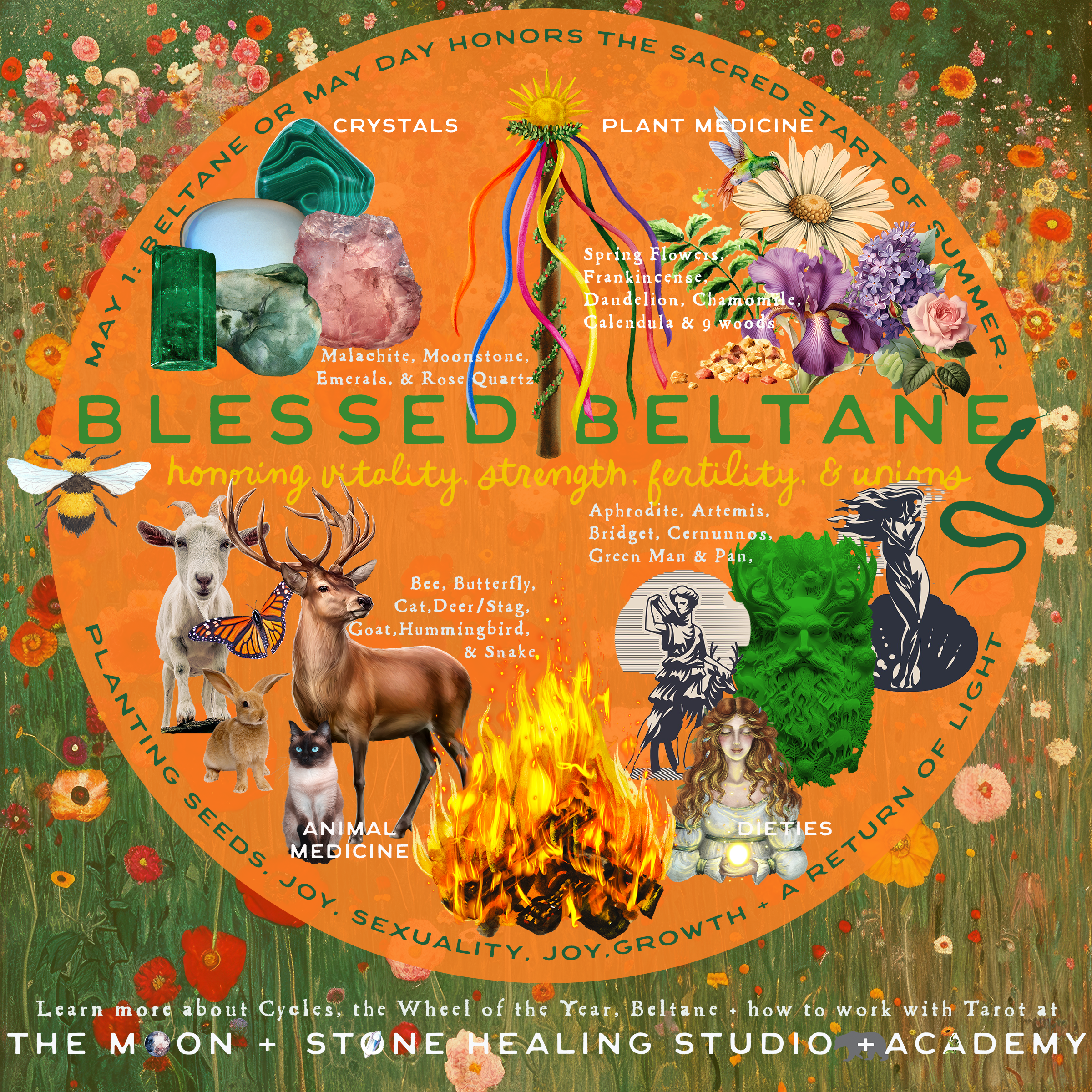
May 1st is also Beltane, or May Day, the energy of fertility, sex, creativity and joy comes through loud and clear and we honor our own fertility and flirty natures. I recorded a podcast with all the history and lore of Beltane as well as a reading.


Imbolc Reading
Enjoy this Collective Imbolc Reading for February 1. And you can try it yourself with this layout from my book the Complete Tarot Layouts:

autumn equinox reading + podcast episode

Blessed Autumn Equinox!!! In my earth-based pagan spiritual practice, we honor gratitude and the abundance of the Earth at this time of the year. Autumn Equinox or Mabon, the second harvest festival in the Wheel of the Year, arrives somewhere between September 20 and 22nd. Though harvest festivals have always been celebrated, the Wiccans, in the mid-20th century, brought us Mabon, named after the Celtic God of the same name. The Wiccan creators wanted to keep the Celtic-focus for the names of the eight festivals in the Wheel of the Year; hence the story of Mabon being featured for Autumnal Equinox. Mabon, a Celtic god, as a child was stolen from his mother and imprisoned deep in the womb of the Earth. At Yule, he will be reborn with the light again.
Like Ostara, the Autumn Equinox honors balance of light and darkness. Unlike Ostara, Mabon examines the move into the darkness. The Greek Eleusinian Mysteries and Rites of Demeter were honored for over two thousand years to honor the move from light to dark. Central to these mysterious rites, which were so secretive that they were never written down, was the story of Demeter and her daughter Persephone, sometimes called Kore. You can read the Homeric Hymn to Demeter translated by Gregory Nagy (my favorite translation). Listen to the podcast episode for more…

Beltane Reading, History + Layout


As the Wheel turns and the grass turns greener, flowers blossom, their pollen heaving, enticing, the pollinators, come and spread seed. Greater Sabbats on the pagan Wheel of the Year are the cross-quarter holidays—what they call the Earth Festivals (as compared to the Solar Festivals that mark the equinoxes and the solstices.) Beltane marks the beginning of the transition from Spring to Summer. It occurs on May 1st. Blossoming flowers, the trees and grass really take off, the bees beginning to buzz…it is a time of lightness and fun, fertility and growth.
Beltane uniquely focuses on sexuality and sensuality with a bevy of yonic and phallic symbols. The Horned God, birthed at Yule, begins to hit his lusty stage, ready to mate with the maiden Earth goddess. Both are honored at this time—Cernunnos (as well as Green Man, Pan, the Oak King) and the Maiden Goddess. Beltane honors our own unions. The Roman festival of Floralia seems to have influenced the way Beltane was celebrated. Beltaine, the Celtic Christian festival meaning “Bright Fire”, honored the release of the cattle into the fields. Standing directly across Samhain on the great Wheel of the Year, Beltane calls in light and lightness in the same way Samhain honors the dark of life. There is a focus during Beltane on life in all its sensuous and corporeal glory.
The celebrations of Beltane are joyous, raucous events with massive bonfires, dancing, singing and more. Beltane fires are said to have healing properties that were used to grant healing prayers and protection. The smoke from the bonfires were used for purification and for vitality. The ashes then were placed in the fields for fertility. Celebrations at Beltane, sometimes called May Day, involved the Maypole—a tall wood pole, a phallic symbol, placed in the center of the festivities. A flower wreath placed on top of the pole served as a yonic symbol of the feminine. Brightly colored ribbon hang from the top of the pole to the ground. Maidens and boys were placed around the pole, grabbing every other cloth or ribbon (men facing one way while the women faces another, so they could look at each other.) They danced, weaving in and out of each other, symbolizing the sexual union of masculine and feminine.
When we look at the world through the agrarian calendar, or the Wheel of the Year, we often find some antiquated ways—particularly around the masculine and feminine. Around Beltane, the idea of the masculine and feminine coming together really meant bringing fertility to the fields for a good harvest. A good harvest meant the difference between life and death. It also meant expanding the family and bringing children into the world. Childbirth brings both the feminine and masculine together forming new life, and in this way, Beltane honors the way sexuality brings together the light-dark, masculine-feminine for new life. We can certainly expand our idea of sexuality now, but the symbolism of Beltane remains in the phallic and the yonic.
During Beltane festivals, couples stayed out in the fields all night, engaging in sexual union, particularly in the fields, to encourage fertility in the crops and soil or in the woods, where they would bring back greenery and flowers to decorate for the celebrations. Babies conceived during these couplings at Beltane were called merry-begots and thought to be blessed by the gods. These couplings were not the only celebrations of unions—marriages and hand fastings often were celebrated during this time.
Magick is thought to be easy to access around Beltane. All manner of people engaged in divination and magickal behavior from the grandmother to the cook who threw his soup bones in the fire to read in the morning. In fact, the two Greater Sabbats of the year, Samhain and Beltane, lying across from each other on the Wheel of the Year, honor the thinness of the veil between the worlds by encouraging us to dive into our Tarot and oracle decks, our runes, and scry into bowls of water, another yonic symbol.
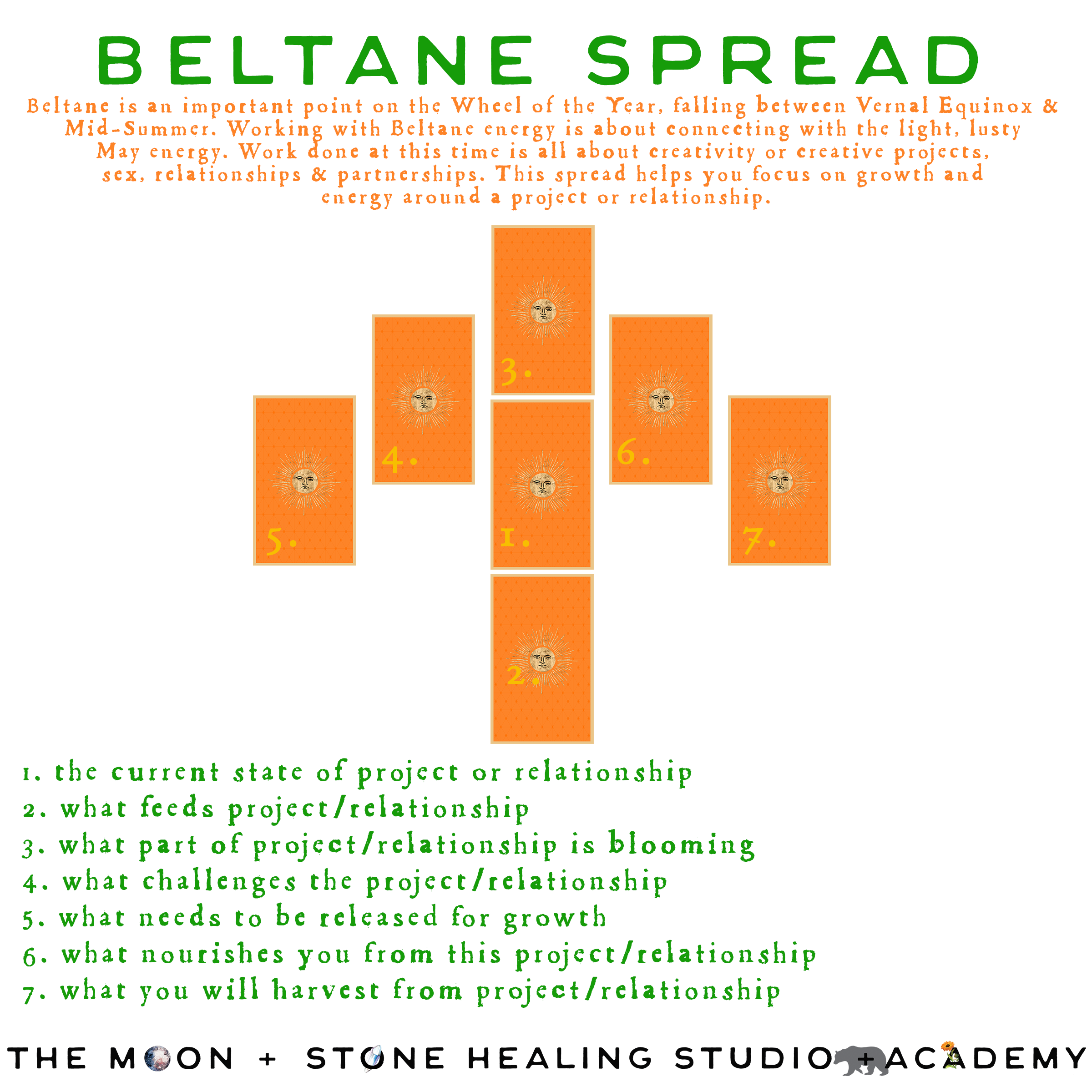
I have been reading Tarot for many moon cycles. As a pagan and an earth medicine practitioner, I have created tarot spreads for each of the points on the Wheel of the Year to help us easily tap into the energetic and magickal work important around these different points on the Wheel of the Year and in our life. Beltane’s sexy energy encourages us to connect with the light, lusty, fertile energy of Beltane and May.
I wanted to share my Tarot Layout from my book the Complete Tarot Layouts. Because the energy of sex and creativity is so intimately tied together, you can use this layout for either. If you are more interested in a creative project, you can also think of that birthing out of the same energy of Beltane. Remember you can do this reading at any time you want to check in with a relationship or project of any kind, not just Beltane. Remember you can use this and any tarot layout with runes, oracles decks or any Tarot deck.

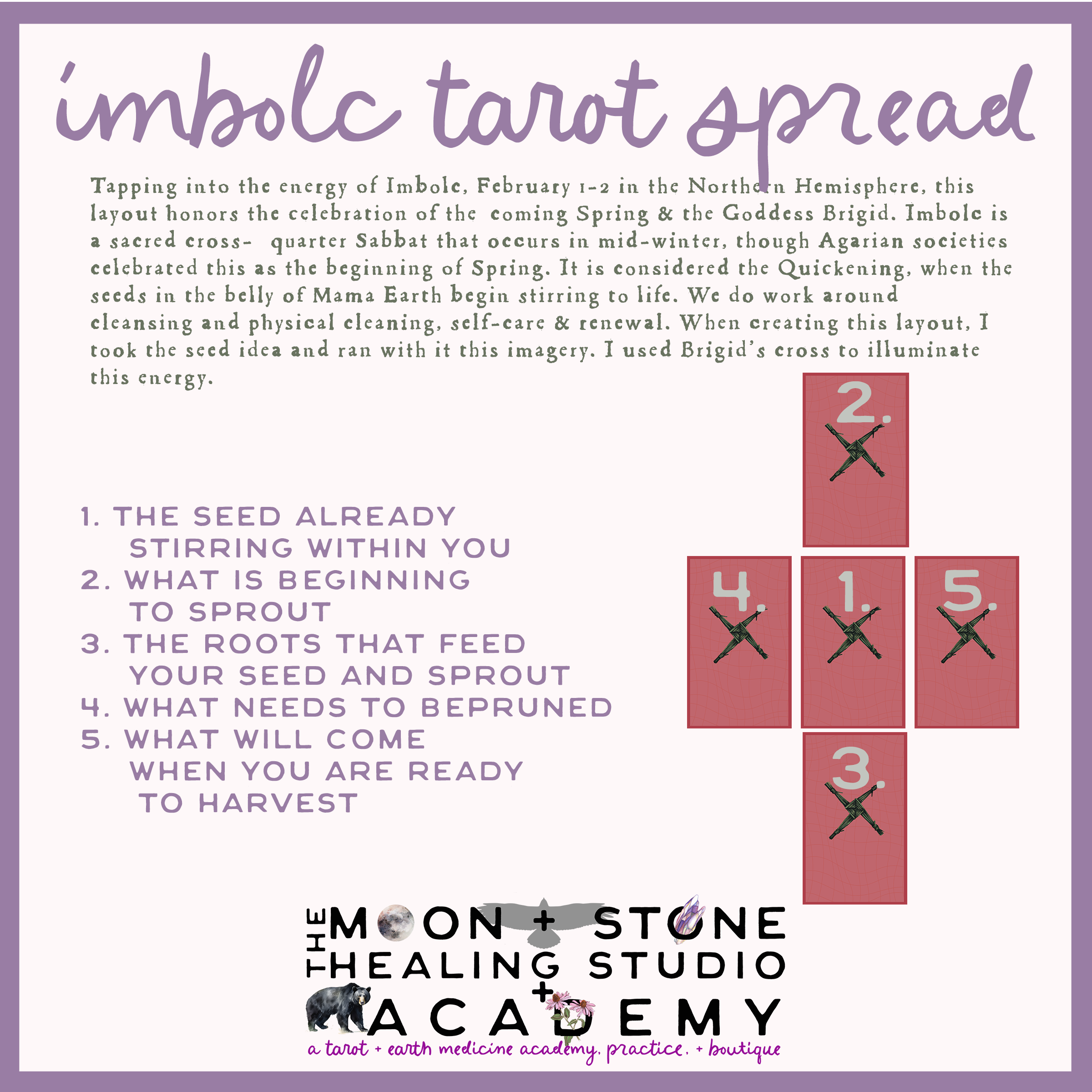
imbolc tarot layout
You know how I love creating tarot layouts for the Wheel of the Year. I have something in the works for those of you who also work with the pagan Wheel of the Year—the equinoxes, solstices and cross-quarter holidays, plus all the moon cycles. I cannot wait to share it with y’all.
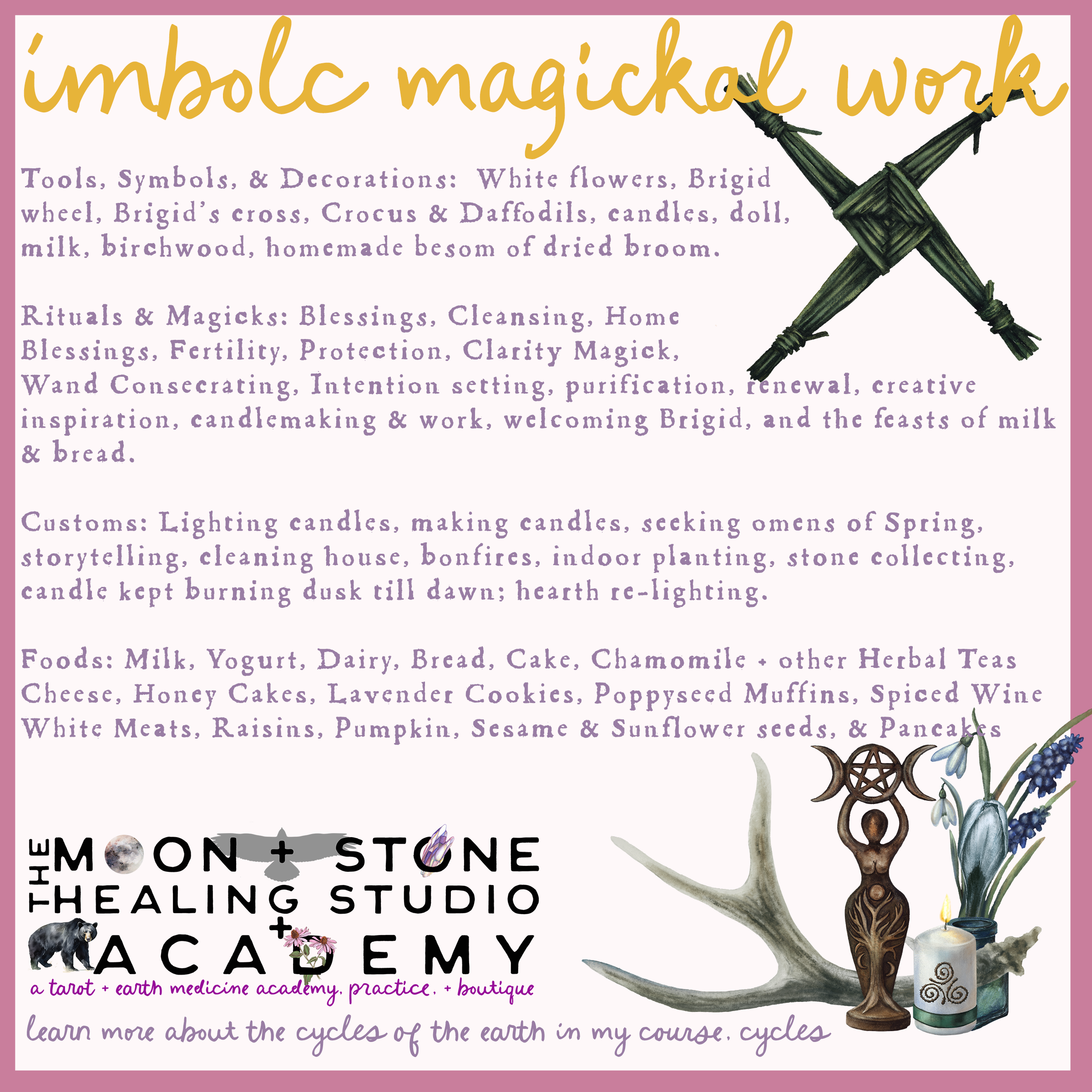
Of course, Imbolc is coming up, so I thought I would design a layout for the seeds beginning to stir within you. Imbolc is basically the halfway point between Yule (Winter Solstice) and Ostara (Vernal Equinox). This is the traditional time that candles are made, and the sheep begin birthing lambs (hence the name Imbolc, pronounced Im-olc, meaning ewe’s milk). The gift of the first milk might help sustain a family in the dark winter. Speaking of darkness, we begin to see the sun rising earlier and setting later. I mean, we hear that Yule is when the sun begins coming out earlier, but now is when we can really see it in action.
It is also traditionally the feast day of St. Brigid, or the Goddess Brigid. Her snake would rise from the soil to test the weather and tell us whether the winter would last for another 6 weeks or longer. (Sound familiar?) But the idea here is under the snow, the grass, the soil, the seeds planted deep in the autumn are beginning to stir. It looks calm and serene above, but the seeds are stirring into action and beginning to make their way toward the sun.
And the same for us. What seeds are beginning to make their way towards the light for you? This tarot layout seeks to understand what is happening below your surface. Let me know if you use this tarot layout and what you think of it.
